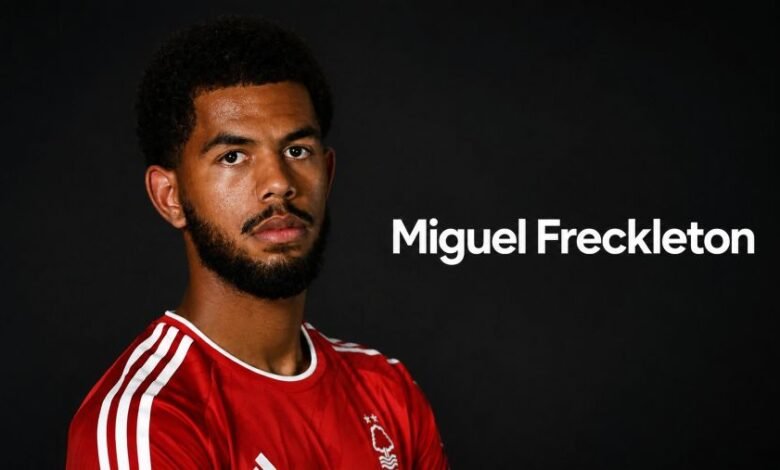
Miguel Freckleton: From Non-League Football to LASK and the Champions League
The Bristol-born defender built his career through senior football rather than a straight academy pathway, turning loan spells into a Scottish top-flight breakthrough, a League Cup triumph and a move to Austria.

Introduction
Miguel Freckleton’s career makes more sense when you look at where he actually played, not simply which club owned his registration.
Sheffield United signed him as a young defender in 2021, but he never became a senior first-team regular at Bramall Lane. Instead, his development happened elsewhere: Wealdstone, Yeovil Town, Chesterfield and Swindon Town. Each loan gave him something the previous one could not — more responsibility, a different competitive environment and, eventually, Football League experience.
Then came St Mirren.
The move to Scotland in 2025 changed his standing. Freckleton became a regular top-flight starter, helped St Mirren beat Celtic to win the Scottish League Cup, scored four Premiership goals from defence and later helped the club survive a relegation play-off. Within a year, Austrian side LASK had signed him on a contract through 2029.
By August 2026, he had also made his UEFA Champions League debut.
It is a rapid rise when viewed from the end point. The years before it were anything but rapid.
Freckleton was born in Bristol on 6 August 2003 and spent part of his youth development with Bristol Rovers.
That academy background did not lead directly into first-team professional football. He later appeared for Mangotsfield United, giving him exposure to non-league football while still a teenager.
That stage matters because it interrupts the familiar academy narrative.
Young players released or moved on from professional systems often have to rebuild their reputation away from the infrastructure of a major club. Freckleton did exactly that. His performances attracted interest from professional sides, and Sheffield United brought him into their development setup in late 2021.
Contemporary reporting also linked Southampton, Cardiff City and Hull City with interest in him. Those reports should be treated as evidence of attention rather than proof that formal offers existed. What is firmly established is that Sheffield United signed him and gave him another route into professional football.
His full name, Miguel Oliver Freckleton, also appears in Football Association intermediary transaction records connected with Sheffield United.
Sheffield United Signed Him, but Loans Built the Player
Describing Freckleton simply as a former Sheffield United defender can create the wrong impression.
He belonged to the club, trained and developed within its system, but did not establish himself in Sheffield United’s senior competitive first team. The meaningful senior minutes came through loans.
That distinction is central to understanding his career.
Rather than waiting for occasional opportunities at a higher-level parent club, he was repeatedly placed in senior environments where points, promotions and relegation battles mattered.
The sequence became increasingly demanding:
Wealdstone → Yeovil Town → Chesterfield → Swindon Town.
By the time he left Sheffield United permanently, he had accumulated considerably more senior experience than his lack of Blades first-team appearances might suggest.
Wealdstone Gave Freckleton His First Sustained Senior Test
Freckleton joined National League club Wealdstone on loan during the 2022–23 season while still 19.
It was an important step. Academy football can develop technique, tactical understanding and physical preparation, but senior non-league football presents different problems: stronger opponents, experienced forwards, difficult away games and immediate consequences for mistakes.
Freckleton adapted well enough to make 14 league appearances.
His first senior goal arrived on 19 November 2022 away to York City. Wealdstone fell behind but recovered to win 2–1, with Freckleton scoring the equaliser.
Yeovil Town later highlighted another useful piece of context when signing him: Wealdstone lost only twice in the 14 league games in which he appeared.
That does not mean Freckleton alone was responsible for those results. Football defensive records are collective. It does, however, show that his first sustained exposure to senior football was productive enough to create another opportunity.
Yeovil Added Experience in a Very Different Situation
In March 2023, Freckleton moved to Yeovil Town on loan.
He made eight league appearances during a difficult period for the Somerset club.
The value of this spell was different from the Wealdstone experience. Young defenders develop not only in successful teams but also when playing under pressure, dealing with territorial disadvantages and trying to manage games where confidence is fragile.
His Yeovil stay was brief, but another block of National League appearances strengthened the pattern that would define his development: he was learning through competitive senior football rather than waiting behind established defenders at Sheffield United.
Chesterfield Brought Promotion Pressure
Freckleton’s next loan moved him into a much stronger competitive position.
He joined Chesterfield for the 2023–24 campaign as the club pushed for promotion from the National League. Chesterfield eventually won the division and returned to the English Football League.
The club recorded 21 Freckleton appearances across competitions during the season.
His role also demonstrated his positional flexibility. Chesterfield noted that he initially impressed at left-back before featuring mainly in central defence.
An injury suffered against Watford interrupted his campaign, preventing him from maintaining an uninterrupted run of matches. Even so, he finished the season as part of a championship-winning squad.
That was an important development. His previous loans had established that he could compete at senior level. Chesterfield exposed him to a team expected to win.
There is a difference.
Playing for a promotion favourite often requires defenders to operate higher up the pitch, defend space behind an attacking team and remain concentrated during matches in which possession is heavily tilted toward their own side.
It also gave Freckleton his first senior team honour.
Swindon Town Was His Step Into the EFL
The 2024–25 season took Freckleton into League Two with Swindon Town.
This loan arguably represented the most important phase of his English development because it provided sustained Football League minutes.
BBC Sport reported that he made 32 appearances in all competitions, including 29 starts. League data records 28 appearances, 25 starts and 2,367 minutes.
For a defender still in his early twenties, that was substantial senior exposure.
By this point, Freckleton was no longer simply a prospect moving between temporary assignments. He had played in different types of teams, experienced a title-winning season and completed a meaningful run in the EFL.
Yet Sheffield United still did not offer a clear first-team route.
The next decision therefore mattered. Instead of another loan, he needed somewhere that would treat him as a first-team player in his own right.
St Mirren provided that opportunity.
St Mirren Turned Experience Into a Top-Flight Breakthrough
St Mirren signed Freckleton permanently in July 2025 following his departure from Sheffield United.
Manager Stephen Robinson immediately pointed toward one of the defender’s strongest selling points: despite being only 21, Freckleton was already approaching 100 senior appearances.
That accumulated experience helped explain why St Mirren could place him directly into Scottish Premiership football.
He responded by becoming a near-automatic selection.
During the 2025–26 Premiership season, Freckleton started all 37 of his league appearances, playing 3,285 minutes.
This was not simply another season of development.
It was his first year as an established defender in a national top division.
The level of responsibility rose sharply. He was dealing with stronger attacking players, higher-profile matches and the weekly scrutiny that comes with top-flight football. St Mirren also had an unusual season, combining a major cup triumph with a serious fight against relegation.
Freckleton was involved in both extremes.
Four League Goals Became Far More Important Than the Number Suggests
Freckleton scored four Scottish Premiership goals in 2025–26 and recorded one assist.
For a centre-back, four league goals is already useful production. At St Mirren, the figure carried extra weight because the team struggled badly for goals.
BBC Sport reported that St Mirren finished with only 27 league goals, and late in the campaign Freckleton was level with forward Mikaël Mandron as the club’s leading Premiership scorer on four.
That statistic should not be misread as evidence that Freckleton suddenly became an attacking player. Instead, it demonstrates two things at once.
First, his height and attacking presence made him a genuine scoring threat from defensive positions.
Second, St Mirren’s forwards were producing so little that goals from a centre-back became unusually important.
His matches against Hearts provided clear examples.
Freckleton scored in a 2–2 draw with Hearts in October 2025. On 3 February 2026, he hurt the same opponent again, scoring the late winner as St Mirren defeated Hearts 1–0.
The second goal carried particular value because Hearts were leading the league at the time.
A defender deciding such matches gives a team something beyond his basic defensive contribution.
Hampden Brought the Biggest Moment of His St Mirren Season
Freckleton’s breakthrough season reached its emotional high point on 14 December 2025.
St Mirren faced Celtic in the Scottish League Cup final at Hampden Park.
Celtic entered with the greater profile and resources. St Mirren left with the trophy.
Freckleton started in central defence as his side won 3–1.
Marcus Fraser opened the scoring before Celtic equalised. Jonah Ayunga then scored twice in the second half to secure the cup for St Mirren.
For Freckleton, the victory was another remarkable jump in the level of his career. Only a few seasons earlier he had been playing National League football on loan. Now he was starting in a major Scottish final and beating Celtic at Hampden.
BBC Sport later reported an unusual part of St Mirren’s pre-match preparation. Robinson had arranged for players to see messages from family members before the final. Freckleton described the experience as emotional and indicated that it had a strong effect on the squad.
The trophy became the defining achievement of his season.
Yet St Mirren’s campaign did not turn into a comfortable success story afterwards.
Cup Winners in December, Fighting Relegation in May
The contrast between St Mirren’s cup campaign and league season is essential context.
Winning a final against Celtic could easily dominate a simplified account of Freckleton’s year. In the Premiership, however, St Mirren struggled enough to finish in the relegation play-off position.
That meant their top-flight status came down to a two-leg tie against Partick Thistle in May 2026.
The first match ended 1–1.
St Mirren then won the second leg 1–0, surviving 2–1 on aggregate.
Freckleton played the full 90 minutes in both matches.
The two experiences — lifting a trophy at Hampden and defending Premiership status five months later — reveal more about his season than either result does alone.
He had experienced success, pressure and uncertainty within the same campaign.
He also finished that season having made 47 appearances across all competitions for St Mirren.
One detail requires care. LASK’s later announcement of his signing stated that he had completed every minute of those 47 matches. Match records contradict that assertion: Freckleton was substituted at half-time against Dundee United on 17 May 2026.
The 47-appearance figure is supported. The every-minute claim should not be repeated as fact.
Why LASK Moved for Miguel Freckleton
Freckleton’s Scottish season was enough to attract interest beyond Britain.
On 2 July 2026, Austrian Bundesliga club LASK announced his signing from St Mirren.
He received a contract running through 2029.
LASK’s official announcement highlighted the characteristics that had followed him through his development: physical strength, speed, aerial ability and the capacity to defend on the left side.
At 1.93 metres, Freckleton certainly provides size. His experience at both centre-back and left-back also gives coaches more options when setting up a back four or a defence requiring a left-sided centre-half.
The move represented another significant step.
Austria offered a new domestic league, a new football culture and — immediately — European competition.
Still, the transfer should not be confused with instant establishment at LASK.
As of 29 August 2026, Freckleton had made only one Austrian Bundesliga appearance according to the club’s league records available during the research period. He was still fighting for regular minutes.
His European introduction arrived much faster.
Champions League Football Arrived Against a Familiar Opponent
There is a striking link between Freckleton’s St Mirren high point and the beginning of his LASK career.
The opponent was Celtic again.
LASK faced the Scottish champions in the 2026–27 UEFA Champions League play-off round.
The first leg went badly. Celtic won 3–0 at Celtic Park, leaving LASK with an enormous deficit to overturn in Austria.
Then came one of the most remarkable results of the qualification campaign.
On 25 August 2026, LASK beat Celtic 5–1 after extra time, advancing 5–4 on aggregate.
Freckleton entered during extra time.
UEFA records his involvement at 21 minutes, giving him his first Champions League appearance.
His role should be kept in proportion. He did not start the comeback or emerge as its central figure.
But the personal symmetry is hard to miss.
In December 2025, Freckleton started as St Mirren beat Celtic to win the Scottish League Cup.
Eight months later, wearing LASK colours, he helped see out extra time as another of his teams eliminated Celtic and reached the Champions League league phase.
That is a far more interesting connection than simply stating that he had “European experience.”
What Kind of Defender Is Miguel Freckleton?
The available evidence supports a fairly clear profile without requiring exaggerated scouting claims.
Freckleton is primarily a centre-back, often suited to the left side of central defence. Earlier in his career he also played at left-back.
His 1.93m frame gives him obvious physical potential in aerial contests, and several managers and clubs have separately highlighted his pace.
His St Mirren numbers also show that he was not merely occupying space in the defensive line.
During the 2025–26 Premiership season, available statistical records credit him with 53 tackles won and 36 interceptions, alongside his four league goals.
Numbers like these need context. Tackles and interceptions are affected by a team’s defensive style, territory and possession levels, so they should not be treated as a universal ranking of defensive quality.
They do show that Freckleton was heavily involved in St Mirren’s defensive work.
His goals add another dimension. At 1.93m and comfortable attacking set pieces, he can contribute at the opposite end of the pitch.
That combination — height, recovery pace, positional flexibility and growing senior experience — explains why a club such as LASK saw further development potential.
Why His Career Path Is More Interesting Than a Conventional Academy Story
Freckleton’s career is a useful example of why player development cannot always be measured by first-team appearances at the club that owns a young player.
Technically, he spent several years attached to Sheffield United.
Practically, Wealdstone, Yeovil, Chesterfield and Swindon shaped much of the senior footballer who later arrived at St Mirren.
Each loan changed the demands.
Wealdstone asked whether he could handle men’s football.
Chesterfield exposed him to promotion pressure.
Swindon gave him sustained EFL competition.
St Mirren then gave him something Sheffield United had not: regular top-flight responsibility.
By the summer of 2026, LASK were not buying an academy prospect with limited match exposure. They were signing a 22-year-old defender who had already played extensively across several senior levels and had just completed a full Scottish top-flight season.
That distinction explains the speed of his later progress.
What Should Be Treated Carefully in Miguel Freckleton Profiles?
Freckleton is still early enough in his career that inaccurate database information can easily spread into biography pages.
The clearest example involves his birth date.
UEFA and several established football databases list 6 August 2003, while FBref has displayed 8 September 2002. The evidence gathered for this article supports the UEFA date.
His Sheffield United record also requires precise wording. He was a Sheffield United player and developed within their system, but he did not establish himself in their senior competitive first team.
Claims about an exact transfer fee for his moves to St Mirren or LASK should also be avoided unless stronger primary evidence becomes available.
Some databases list Jamaican citizenship in addition to English nationality. That does not make him a Jamaica international, and there is no evidence in the sources reviewed for this article that he has represented Jamaica at senior international level.
The same caution applies to personal details. Reliable reporting offers little verified information about his parents, relationships, private life or finances. Filling those gaps with unsourced biography material would make an otherwise accurate profile weaker.
The Next Challenge Is Becoming a LASK Regular
Freckleton has already completed several difficult transitions.
Non-league football to Sheffield United’s development setup.
National League to League Two.
League Two to the Scottish Premiership.
St Mirren to LASK.
The next step is different because it does not require another transfer.
It requires playing.
His Champions League appearance against Celtic gave him a high-profile European introduction, but his limited Austrian Bundesliga minutes by late August 2026 show that he had not yet secured a permanent starting position.
That makes his situation at LASK especially interesting.
He arrives with enough senior experience to compete immediately, yet at 23 he remains young enough to improve considerably. European matches increase his exposure, but regular domestic selection will give a much clearer indication of where he stands in LASK’s defensive hierarchy.
Final Thought
Miguel Freckleton’s rise has not been built around one academy breakthrough or a sudden run of attention.
It has been cumulative.
Non-league football reopened a professional opportunity. Four loans supplied the senior minutes Sheffield United could not. St Mirren trusted him in a top division, and he responded with 37 league starts, four goals, a Scottish League Cup winner’s medal and a successful relegation play-off.
LASK then took him into another league and, within weeks, he had stepped onto the pitch in the Champions League.
The important question now is no longer whether Freckleton can work his way upward. His career has already demonstrated that.
It is whether he can turn that steady progression into a lasting starting role at a club competing domestically and in Europe.
FAQs
Who is Miguel Freckleton?
Miguel Freckleton is an English professional football defender from Bristol who plays for Austrian Bundesliga club LASK.
How old is Miguel Freckleton?
Freckleton was born on 6 August 2003, making him 23 years old as of August 2026.
What position does Miguel Freckleton play?
He primarily plays as a centre-back and has also been used on the left side of defence.
How tall is Miguel Freckleton?
LASK lists Freckleton at 1.93 metres, approximately 6ft 4in.
Did Miguel Freckleton play for Sheffield United?
He was contracted to Sheffield United and developed within their system, but he did not establish himself in their senior competitive first team. Most of his senior experience came through loans.
Which clubs has Miguel Freckleton played for?
His senior career has included Mangotsfield United, Sheffield United, Wealdstone, Yeovil Town, Chesterfield, Swindon Town, St Mirren and LASK.
Did Miguel Freckleton win a trophy with St Mirren?
Yes. He started when St Mirren beat Celtic 3–1 in the Scottish League Cup final on 14 December 2025.
When did Miguel Freckleton join LASK?
LASK announced his signing on 2 July 2026, giving him a contract through 2029.
Has Miguel Freckleton played in the Champions League?
Yes. He made his UEFA Champions League debut for LASK against Celtic on 25 August 2026, playing during extra time as LASK won 5–1 and advanced 5–4 on aggregate.
Is Miguel Freckleton a Jamaica international?
No senior Jamaica appearance was established in the sources reviewed. Some databases list Jamaican citizenship, but he should not be described as a Jamaica international without supporting evidence.