Rachel Botsman and the Ideas That Changed How We Think About Trust
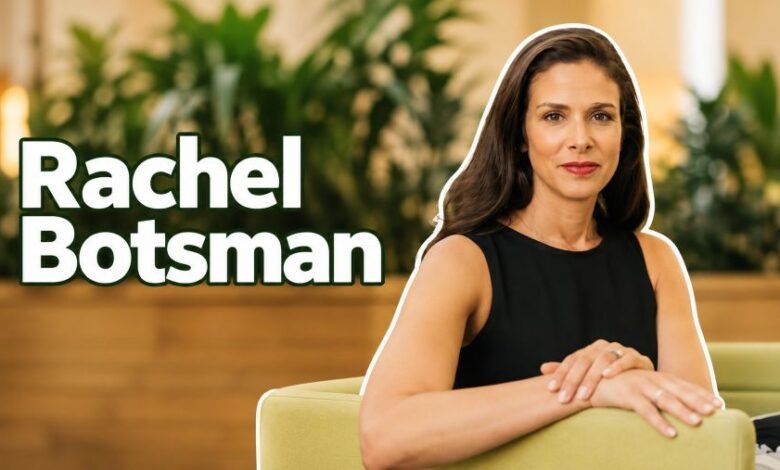
Rachel Botsman is a British author, researcher, lecturer and speaker known for her work on collaborative consumption, digital trust and the way technology changes human behaviour.

Introduction
Rachel Botsman is best known for asking a simple question: why do we trust?
Her work looks at trust between people, companies, institutions and technology. She first became widely recognised through her writing on collaborative consumption, then moved into research about digital trust and how people decide whether another person, platform or system can be trusted.
As of September 2026, Botsman continues to work as an author, speaker, lecturer and trust expert. She also works with art and design to explain ideas about organisations, leadership and human behaviour.
Quick Facts About Rachel Botsman
| Fact | Detail |
|---|---|
| Full professional name | Rachel Botsman |
| Documented full name | Rachel Louise Botsman |
| Birth year | 1978 |
| Nationality | British |
| Profession | Author, researcher, lecturer and speaker |
| Main area of work | Trust, technology and leadership |
| Education | Fine Art, University of Oxford |
| Known for | Collaborative consumption and distributed trust |
| Major books | What’s Mine Is Yours and Who Can You Trust? |
| Former Oxford role | Trust Fellow at Saïd Business School |
| Current base | Oxford, England |
| Current work | Writing, speaking, teaching and trust research |
Who Is Rachel Botsman?
Rachel Botsman is a British thinker whose work sits between business, human behaviour and technology.
That sounds broad. Her main idea is much simpler.
She studies trust.
Botsman looks at why someone may trust a stranger online, why trust in large institutions can weaken, and why people sometimes feel comfortable giving technology access to information or decisions they once kept firmly under human control.
Her work became widely known during the growth of companies built around sharing, renting and peer-to-peer transactions.
Think about services where strangers rent homes, share cars or sell directly to one another.
Those services need trust.
Botsman helped explain why.
Rachel Botsman’s Education
Botsman studied Fine Art at the University of Oxford.
Her background is interesting because she did not begin with the usual route into management research, economics or computer science.
She came from art.
That training still appears in her work today. She often uses visual ideas and design to explain how organisations, technology and people connect.
Publisher material for her first book also states that she later undertook postgraduate study at Harvard University.
The public source does not identify a completed Harvard degree, so it is safer to describe this simply as postgraduate study.
Her Early Career
Before becoming widely known as an author, Botsman worked in strategy and innovation.
She also served as a director at the William J. Clinton Foundation, according to public profiles from recognised organisations.
She later founded Collaborative Lab, which focused on changes in consumer behaviour, technology and shared access.
These experiences fed directly into the idea that would make her name familiar to a much larger audience.
What Is Collaborative Consumption?
In 2010, Rachel Botsman and Roo Rogers published What’s Mine Is Yours: The Rise of Collaborative Consumption.
The book looked at a changing habit.
People did not always need to own something.
They could share it.
Rent it.
Swap it.
Borrow it.
Or gain temporary access to it.
Botsman and Rogers used the term collaborative consumption to describe many of these systems.
The idea arrived during a period when digital platforms were making it much easier for strangers to connect directly.
Botsman also discussed the subject in Harvard Business Review and gave a TED talk called “The case for collaborative consumption” in 2010.
That helped take the idea far beyond academic and business circles.
Why Trust Became Her Main Subject
Collaborative consumption raised another question.
Why would strangers cooperate?
Basically, trust was doing a lot of the work.
Botsman began looking more closely at ratings, reviews, reputation systems and online platforms.
In 2012, she gave another TED talk titled “The currency of the new economy is trust.”
Her focus was starting to change.
The question was no longer only about sharing.
It was about why people were willing to trust strangers they had never met.
That theme became central to almost everything that followed.
Distributed Trust
Botsman later used the term distributed trust to describe a wider change in society.
For much of modern history, people often placed trust in large organisations such as banks, governments, newspapers and established companies.
Online platforms changed that pattern.
People began trusting individual sellers.
Drivers.
Hosts.
Reviews.
Algorithms.
Networks of strangers.
Her 2016 TED talk, “We’ve stopped trusting institutions and started trusting strangers,” explained this shift to a large public audience.
The talk became one of her most recognised presentations.
Who Can You Trust?
In 2017, Botsman published Who Can You Trust? How Technology Brought Us Together – and Why It Could Drive Us Apart.
The book looked at what happens when trust moves away from traditional institutions and toward digital systems.
It also introduced readers to what Botsman calls a trust leap.
A trust leap happens when someone takes a risk with a person, system or idea before they fully know what will happen.
That idea matters even more now.
AI systems, online marketplaces and automated services regularly ask people to make these kinds of decisions.
Do I trust this system?
Do I trust its answer?
Do I trust the company behind it?
Those questions sit right inside Botsman’s work.
Rachel Botsman at Oxford
Botsman became the first Trust Fellow at Saïd Business School, University of Oxford.
The World Economic Forum states that she created Oxford University’s first course on trust in the digital world.
That role became an important part of her public profile.
Still, there is one detail writers should get right.
Botsman’s current official profile describes her as a former Trust Fellow.
So articles published in 2026 should not present the fellowship as her current position.
She still teaches and speaks about trust, leadership and technology.
Her Work on Trust and Leadership
Botsman’s research also looks at how trust works inside organisations.
She has discussed several factors people use when deciding whether someone is trustworthy, including competence, reliability, integrity and concern for others.
Simple idea.
Hard to get right.
A leader may have the skills to do a job but still lose trust if people question their reliability or honesty.
Botsman’s work asks companies to separate the idea of liking someone from the harder question of whether that person or system deserves trust.
How to Trust and Be Trusted
Pushkin released Botsman’s audio work How to Trust and Be Trusted in January 2025.
The project takes ideas from years of trust research and applies them to everyday work and relationships.
It looks at how trust can be given, earned and repaired.
That last part matters.
Trust can break quickly.
Repair usually takes longer.
The work is more practical than some of her earlier writing and focuses on how people can handle trust inside real organisations and professional relationships.
Roots of Trust
Botsman returned more clearly to her Fine Art background in 2025.
She created Roots of Trust, an installation shown at the London Design Biennale.
The work was based on an organisational chart created for the New York and Erie Railroad in 1855.
Most modern organisational charts place senior leaders at the top.
This old diagram worked differently.
Leadership appeared near the roots.
Workers spread outward like branches.
Botsman used the image to ask how companies think about hierarchy, power and responsibility.
It was a neat return to where she started: art.
Rachel Botsman’s Work in 2026
As of September 2026, Botsman’s work still centres on trust.
But the subject has widened.
AI is now a major part of the conversation.
She writes and speaks about what happens when people begin relying on machines for answers, memory, judgement and decision-making.
She also continues to speak about leadership, organisational culture and human behaviour.
The World Economic Forum lists her as an author, artist and trust expert connected with Rachel Botsman Ltd.
Her official website also describes her current work across writing, speaking, teaching, art and design.
Rachel Botsman’s Books and Major Work
Her best-known published work includes:
What’s Mine Is Yours
Published with Roo Rogers in 2010, the book explained the rise of collaborative consumption and new forms of sharing and access.
Who Can You Trust?
Published in 2017, this book examined the movement from institutional trust toward trust placed in people, platforms and technology.
How to Trust and Be Trusted
Released by Pushkin in 2025, this audio work looks at practical ways people give, build and repair trust.
Botsman has also presented three major TED talks and created radio, newsletter and design work around the same broad subject.
Public Speaking and TED Talks
Botsman has delivered three well-known TED talks.
They trace the direction of her career quite neatly.
The first focused on collaborative consumption.
The second focused on trust in online economies.
The third examined declining trust in institutions and growing trust between strangers.
Her official profile states that her TED talks have been viewed more than five million times.
She now speaks regularly to organisations about trust, leadership and AI.
Rachel Botsman’s Personal Life
Botsman’s official website says she is based in Oxford, England.
She has publicly mentioned her husband and children in her own writing and interviews.
Her official profile also mentions gardening, running, spending time with her family and her dog.
There is little reason to go further.
Her professional work is the part of her life that is strongly documented, and unsupported personal details should not be added simply to make a profile longer.
Rachel Botsman Net Worth
There is no reliable public source that establishes a verified personal net worth for Rachel Botsman.
Generic net-worth websites should not be treated as proof.
Public UK company records do confirm business activity.
Botsman is an active director of Rachel Botsman Limited, a company incorporated in 2018.
She is also recorded as a director of Liko Designs Limited.
These records confirm company roles.
They do not prove her personal wealth, salary or total ownership value.
Why Rachel Botsman’s Work Still Matters
Think about everyday life.
People book rooms from strangers.
They get into cars with drivers they have never met.
They buy products from sellers on the other side of the world.
Now they ask AI systems for advice, writing, research and decisions.
Trust sits behind each step.
That is why Botsman’s work has stayed relevant even as the technology around it keeps changing.
Her subject was never really one company or one platform.
It was human behaviour.
Verified Interesting Facts About Rachel Botsman
Botsman studied Fine Art before becoming known for work on business and technology.
She has delivered three TED talks.
She helped popularise the term collaborative consumption through What’s Mine Is Yours.
She later moved her research toward distributed trust and trust in digital systems.
She became Oxford’s first Trust Fellow at Saïd Business School.
She created Roots of Trust for the London Design Biennale in 2025.
Her public work now increasingly deals with trust and AI.
Final Thought
Rachel Botsman’s career follows one clear question.
Who do we trust?
First, she looked at strangers sharing goods and services.
Then came platforms and reputation systems.
Now AI has pushed the question somewhere new.
Botsman’s work keeps examining that change through books, talks, teaching, writing and design. For readers trying to understand why people trust technology, strangers or organisations, that remains the main reason her work gets attention.
Frequently Asked Questions
Who is Rachel Botsman?
Rachel Botsman is a British author, researcher, lecturer and speaker known for her work on trust, technology and collaborative consumption.
What is Rachel Botsman known for?
She is best known for her ideas about collaborative consumption, distributed trust and how technology changes who people trust.
What did Rachel Botsman study?
She studied Fine Art at the University of Oxford.
What books has Rachel Botsman written?
Her major books include What’s Mine Is Yours, written with Roo Rogers, and Who Can You Trust?
Did Rachel Botsman work at Oxford University?
Yes. She was the first Trust Fellow at Saïd Business School, University of Oxford. Her current profile describes her as a former Trust Fellow.
What is collaborative consumption?
It describes systems where people share, rent, swap, lend or gain access to products and services instead of always owning them.
What does Rachel Botsman mean by distributed trust?
It describes trust moving away from large central institutions toward individuals, networks, platforms and technology.
Where is Rachel Botsman now?
As of September 2026, she is based in Oxford and continues working as an author, speaker, lecturer and trust expert.