Advertising in the AI Era: How Brands Win When Machines Shape Attention
AI is changing how advertisements are created, bought, targeted and discovered. The brands that win will pair automation with original ideas, reliable data and human judgment.

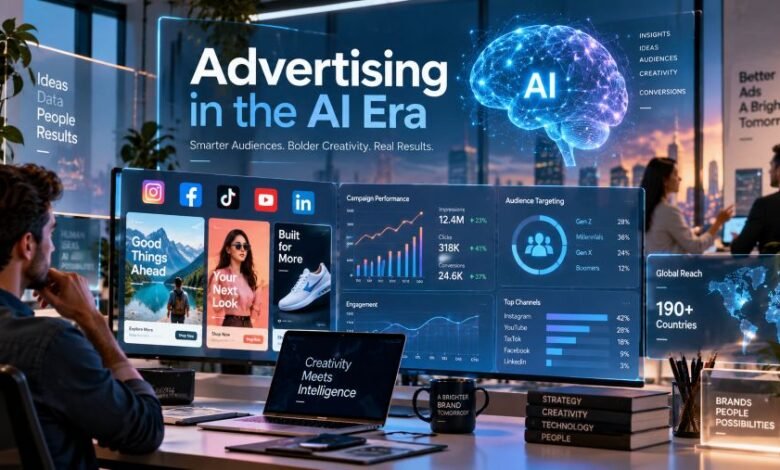
Quick Answer
Advertising in the AI Era means using artificial intelligence across the advertising process—from finding audiences and generating creative to setting bids, analysing results and reaching consumers inside AI-powered search and conversational platforms.
The biggest change is simple: advertisers are no longer managing every keyword, audience and ad variation by hand. AI systems increasingly make those decisions in real time.
Advertising Has Entered a Different Phase
Digital advertising has used machine learning for years. Recommendation engines, automated bidding and audience modelling are not new.
What is new is the scale.
Generative AI can now produce headlines, product descriptions, images and video. Advertising platforms can interpret broader customer intent instead of depending only on exact keywords. AI assistants themselves are becoming places where people compare products and make purchasing decisions.
The money following these changes is substantial. In September 2026, IAB raised its forecast for U.S. advertising spending growth to 12.3% for 2026. Its research also found that 76% of surveyed buyers were increasing their focus on content for AI-generated answers, while 72% were focusing more heavily on large language models.
Advertising is not disappearing.
Its mechanics are being rewritten.
From Keywords to Customer Intent
Traditional search advertising worked around a fairly predictable sequence.
A person typed a keyword. Advertisers bid on it. Search engines displayed relevant ads.
That system still exists, but AI search makes the journey much less linear.
People can now ask lengthy questions, compare several products at once or continue a conversation through multiple follow-up questions. A platform has far more context about what the person is trying to achieve.
Google’s AI Max for Search is one example. It uses existing keywords, creative material and website URLs to identify additional relevant searches, including queries not explicitly covered by an advertiser’s keyword list. Google says advertisers activating AI Max typically see around 14% more conversions or conversion value at a similar CPA or ROAS, based on its internal 2025 data for non-retail advertisers.
This changes the advertiser’s job.
Choosing keywords still matters, but feeding advertising systems strong product information, landing pages, brand rules and conversion data matters much more than before.
AI Assistants Are Becoming Advertising Channels
Search engines are not the only place changing.
Conversational AI is becoming commercial territory too.
OpenAI now offers advertising in ChatGPT, allowing advertisers to reach people while they research choices, compare alternatives and consider purchases. In 2026, the company also introduced CPC bidding, expanded measurement features and a self-service Ads Manager.
Google is moving in a similar direction inside AI-powered Search. In May 2026 it announced experimental Gemini-powered formats such as conversational discovery ads, highlighted answers and expanded Direct Offers. Some formats are designed to appear during research rather than waiting until a shopper types a conventional commercial keyword.
That creates a new advertising question:
How does a brand become part of an AI-assisted buying conversation?
Ranking for ten commercial keywords may no longer be enough.
Brands need information that machines can understand, reliable product feeds, clear pricing, strong authority signals and useful content that answers real buying questions.
AI Is Producing More Advertising Creative
Creative production is one of the most visible uses of AI.
A marketing team can start with one product photo and generate several backgrounds. A short piece of copy can become multiple ad variations. Video can be created from still images. Campaign messaging can be adapted for different audiences.
The scale is already significant.
Google reported that advertisers created nearly 70 million Gemini-generated creative assets during Q4 2025 through AI Max and Performance Max. It also said the number of Gemini-generated assets created during 2025 was three times higher than the previous level.
Meta is also bringing newer image-generation technology into its advertising stack, including planned use of its Muse Image model through Advantage+ creative.
For smaller companies, this can reduce one long-standing disadvantage.
A local company that cannot afford a large creative department may still produce dozens of usable variations for testing.
But quantity creates another problem.
If everybody can generate 100 ads quickly, simply having more creative stops being an advantage.
Originality becomes more valuable.
Human Creativity Still Matters
AI is very good at variations.
It is less reliable at knowing which idea deserves to exist in the first place.
A system can generate ten versions of a headline. It cannot automatically give a company a meaningful reputation, years of customer knowledge or a distinctive point of view.
That is why completely automated creative can become repetitive.
The same structures appear again. Similar imagery. Similar claims. Similar wording.
Consumers notice.
IAB research published in January 2026 found a continuing gap between advertisers’ enthusiasm for AI-created advertising and how younger consumers feel about it. The study also found growing concern about quality while suggesting that appropriate disclosure can improve consumer confidence.
The sensible model is therefore not AI instead of people.
It is:
Human idea → AI-assisted production → human review → testing → improvement.
That preserves speed without allowing the brand to sound like everybody else.
Personalisation Becomes Much Easier
Older advertising campaigns often divided consumers into broad groups.
Age.
Location.
Gender.
Device.
Maybe a few interests.
AI can interpret far richer combinations of behaviour and context.
One person might respond to price. Another needs reassurance. Someone else wants technical specifications. A fourth shopper may be almost ready to purchase but needs to know whether delivery is available tomorrow.
AI-driven advertising systems can choose different combinations of creative, products and messages depending on those signals.
This makes personalisation far more practical at scale.
Still, there is a limit.
Personalisation should feel useful, not intrusive.
Advertisers that misuse consumer information may win a click and lose trust.
First-Party Data Becomes More Valuable
For years, marketers could rely heavily on third-party tracking.
Privacy rules, browser changes, platform restrictions and signal loss have made that model less dependable.
AI does not remove the problem.
In some cases, it makes high-quality business data even more important.
An advertising system trained on poor conversion signals will make poor decisions faster.
Companies therefore need clean first-party information such as:
- genuine purchases;
- qualified leads;
- customer lifetime value;
- product availability;
- cancellations and returns;
- CRM information;
- repeat purchases.
This gives AI something meaningful to learn from.
A campaign reporting every weak enquiry as a valuable conversion may teach an automated bidding system to chase more weak enquiries.
Garbage in, garbage out still applies.
Advertising Measurement Is Being Rebuilt
One of the hardest questions in modern advertising is attribution.
Which ad caused the sale?
Was it the search advertisement someone clicked yesterday? The creator video they watched last week? An AI recommendation? A social advertisement? An email?
The answer is often a mixture.
IAB’s September 2026 research found that 86% of surveyed advertising buyers had already changed, or expected to change, their media measurement approach within 12 months because of conversational AI tools and AI agents.
IAB has also highlighted continuing problems caused by fragmented data, privacy restrictions and platform-controlled measurement systems.
Brands should therefore look beyond a single metric such as clicks.
Revenue, qualified leads, incrementality, customer acquisition cost, repeat purchasing and profit provide a stronger picture.
AI Visibility Is Becoming a Marketing Metric
There is another measurement category appearing: AI visibility.
Suppose someone asks an AI assistant:
“Which accounting software is best for a small construction company?”
Three brands are mentioned.
Seven competitors are absent.
That recommendation has value even if there is no traditional search-results page involved.
Companies are already building tools to measure how often brands appear within AI-generated recommendations. IAB responded in August 2026 with measurement guidance because different AI-visibility providers were producing inconsistent results from different methodologies.
This area will probably sit beside traditional SEO, paid search and brand monitoring rather than replacing them.
Marketers will increasingly ask:
Are people seeing us when AI helps them make decisions?
Agentic Advertising Goes One Step Further
Generative AI creates things.
Agentic AI can perform tasks.
That distinction matters.
An advertising agent could analyse campaign data, move budget, change bids, identify weak creative, generate replacements and recommend another audience—all with far less manual involvement.
IAB’s January 2026 outlook found that five of buyers’ top six focus areas involved AI, with roughly two-thirds specifically focused on agentic AI for advertising buying and campaign execution.
This does not mean marketers disappear.
Their responsibility moves upward.
Instead of adjusting hundreds of small settings every day, they increasingly define goals, economics, customer value, restrictions and brand boundaries.
The machine handles more execution.
People decide what success actually means.
The Danger of Black-Box Advertising
Automation creates efficiency, but it can also hide decisions.
Why was one customer targeted?
Why did spending suddenly move toward one audience?
Why did the system create a particular claim?
Why did cost per acquisition increase?
Teams should not give AI unlimited authority simply because a platform labels something “smart.”
Controls still matter.
So do experiments.
Google, for example, provides AI Max experiments that allow advertisers to test AI-powered Search features using traffic within an existing campaign before applying them more broadly.
Good marketers will automate aggressively while continuing to test what the automation is actually doing.
Transparency Will Matter More
AI can create convincing photographs, voices, spokespersons and video.
That power brings responsibility.
The IAB’s 2026 AI Transparency and Disclosure Framework takes a risk-based approach. It does not argue that every use of AI needs a label. Instead, it focuses disclosure on situations where AI materially changes authenticity, identity or representation in a way that could mislead consumers.
Meta has also expanded its advertising transparency work to cover AI material produced through third-party tools and has introduced additional AI-related information through its “About this ad” experience.
The basic legal principle remains straightforward.
AI does not make false advertising acceptable.
The U.S. Federal Trade Commission states that advertising claims must be truthful, non-deceptive and supported by appropriate evidence.
If AI writes a false product claim, the advertiser cannot blame the machine.
What Businesses Should Do Now
Companies do not need to replace their entire marketing strategy.
They need to prepare the foundations.
Start with strong conversion tracking and first-party data. Give advertising platforms accurate product information. Test AI-assisted campaigns against existing approaches instead of assuming they perform better.
Build a library of original photography, video, customer insights and brand material that AI can work from.
Create useful website content around genuine customer questions. Consumers increasingly ask AI systems detailed questions rather than typing two-word searches.
Keep human approval for sensitive creative.
Measure sales quality, not simply lead volume.
And watch AI discovery alongside Google Search, social media and other established channels.
The strongest businesses will not automate everything.
They will automate the repetitive parts and spend more human time on strategy, offers, positioning and customer understanding.
Does AI Mean Traditional Advertising Is Dead?
No.
Television, search, social media, digital video, creators, commerce media and outdoor advertising still attract enormous investment.
In fact, IAB expects U.S. digital video advertising alone to exceed $80 billion in 2026.
What is changing is the intelligence sitting behind those channels.
A video ad may still look like a video ad.
Behind it, however, AI may have helped create the footage, selected the audience, predicted response, adjusted bidding, chosen placement and measured results.
That invisible layer is where much of the advertising change is happening.
Final Thought
Advertising in the AI age is becoming faster, more automated and more conversational.
That does not make marketing easier.
It changes where the difficult work happens.
Producing 50 advertisements is becoming cheap. Knowing what customers actually care about is not. Buying thousands of impressions can be automated. Building a name people trust cannot.
AI will give advertisers stronger tools.
The advantage will belong to businesses that give those tools better data, stronger ideas and clear rules.
Machines can run more of the campaign.
The brand still has to give people a reason to care.
Frequently Asked Questions
What is advertising in the AI era?
It is advertising where AI assists with creative production, targeting, bidding, audience analysis, measurement and consumer discovery.
How is AI used in advertising?
AI can write ad variations, generate images and video, predict audience response, adjust bids, match ads with customer intent and analyse campaign results.
Will AI replace advertising agencies?
It will automate many production and campaign-management tasks, but strategy, positioning, client understanding, creative direction and accountability still require strong human input.
Can small businesses use AI advertising?
Yes. AI tools can give smaller teams access to creative production and campaign automation that previously required larger budgets and specialist teams.
What is AI-powered search advertising?
It refers to advertisements displayed or selected within search experiences where AI interprets wider context and customer intent rather than depending solely on traditional keyword matching.
Can brands advertise inside AI assistants?
Yes. Advertising has already begun appearing in conversational AI environments, including ChatGPT, while Google is testing and expanding advertising formats inside AI-powered Search experiences.
Should AI-generated advertisements be disclosed?
It depends on the circumstances and applicable law. Current IAB guidance recommends disclosure particularly when AI materially changes identity, authenticity or representation in a way that could mislead consumers.
What is the biggest advertising skill for the AI era?
Understanding customers remains the foundation. AI can execute faster, but useful data, original positioning, strong offers and sound judgment determine what it should execute.