William MacAskill: Career, Books, Oxford Work and AI Research
The Scottish philosopher helped build the effective altruism movement, spent years teaching at Oxford, wrote major books on moral choices, and now works on questions linked to advanced AI.

Introduction
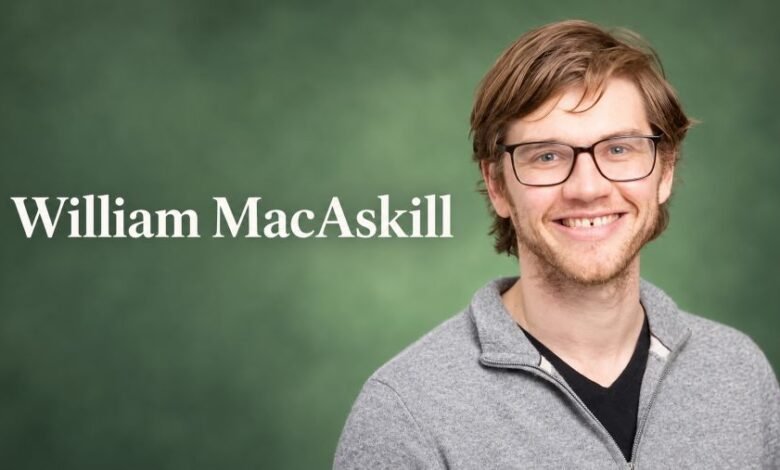
William MacAskill is a Scottish moral philosopher, author, and researcher. He became widely known through effective altruism, a movement that asks how people can use money, careers, and resources to do more good.
His work has changed with time.
For years, Oxford was central. Today, that is different.
As of September 2026, MacAskill is a Senior Research Fellow at Forethought, where his current research looks at how society may prepare for very capable AI systems and the social changes they could bring.
He was an Associate Professor of Philosophy at the University of Oxford from 2015 to 2024.
He is also known for helping start organisations including Giving What We Can, 80,000 Hours, and the Centre for Effective Altruism.
Quick Facts
| Detail | Verified Information |
|---|---|
| Full professional name | William “Will” MacAskill |
| Birth year | 1987 |
| Background | Scottish |
| Grew up in | Glasgow, Scotland |
| Profession | Moral philosopher, author, researcher |
| Current role | Senior Research Fellow at Forethought |
| Oxford role | Associate Professor of Philosophy, 2015–2024 |
| Main known work | Effective altruism, longtermism, moral uncertainty |
| Current research area | AGI preparedness and advanced AI |
| Major book | Doing Good Better |
| Major book | What We Owe the Future |
| Academic book | Moral Uncertainty |
| Organisation co-founded | Giving What We Can |
| Organisation co-founded | 80,000 Hours |
| Organisation co-founded | Centre for Effective Altruism |
Who Is William MacAskill?
MacAskill is best known for asking one basic question.
How can people help better?
That question shaped much of his work.
He became one of the main public figures linked with effective altruism, a community that uses evidence and comparison when thinking about charity, careers, global problems, and ways to help others.
That work reached far beyond universities.
His books brought the ideas to general readers. His organisations built communities around them. His Oxford career gave the work an academic base.
Right now, though, his focus is different.
His recent work looks heavily at artificial intelligence.
Early Life and Background
MacAskill grew up in Glasgow, Scotland.
Reliable reporting places his birth in 1987.
The New Yorker has reported that he was born William Crouch and later kept the MacAskill surname after his marriage ended.
His interest in moral philosophy became serious while he was young.
A major early influence was philosopher Peter Singer.
MacAskill has spoken about reading Singer’s essay Famine, Affluence, and Morality while studying.
That reading changed his thinking.
Basically, the argument asked whether people with spare resources have stronger duties to help people facing serious suffering.
MacAskill started looking at that question more closely.
Then he began testing different answers.
Education
MacAskill studied at major universities.
His education included Cambridge, Princeton, and Oxford.
At Oxford, his doctoral research focused on what philosophers call normative uncertainty.
The idea is fairly simple.
People often disagree about morality.
Sometimes, even one person feels unsure.
So what should someone do when they are uncertain about which moral view is correct?
That question became one of MacAskill’s main academic interests.
His Oxford doctoral thesis, completed in 2014, was titled Normative Uncertainty.
Years later, the same subject became the base for another major academic book.
Giving What We Can
In 2009, MacAskill helped build Giving What We Can with philosopher Toby Ord and others.
The group asked people to think more carefully about charitable giving.
One of its best-known ideas is the 10% Pledge.
People who take that pledge commit part of their income to charities they believe can help effectively.
The group grew from a small Oxford project into an international community.
Its work also helped create the early base for effective altruism.
Starting 80,000 Hours
MacAskill co-founded 80,000 Hours with Benjamin Todd in 2011.
The name comes from a rough idea.
A career takes a lot of time.
Tens of thousands of hours.
So career choice can matter.
80,000 Hours researches careers that may let people work on large global problems.
That can include research, government, policy, technology, health, and other fields.
The project became one of the most visible organisations connected with effective altruism.
Centre for Effective Altruism
MacAskill also helped found the Centre for Effective Altruism.
Its current institutional history dates the organisation to 2011.
Older material from MacAskill’s own site has sometimes given 2012.
The Centre for Effective Altruism helped connect organisations, researchers, donors, events, and people working around the same basic ideas.
This period also helped spread the name effective altruism.
MacAskill became one of the movement’s main public speakers.
That brought attention.
It brought criticism too.
Oxford Career
MacAskill completed his Oxford doctorate in 2014.
Then his academic career moved quickly.
In 2015, he became an Associate Professor of Philosophy at the University of Oxford.
He was 28.
Contemporary profiles described him as the world’s youngest philosophy associate professor at that time.
He stayed in the Oxford role until 2024.
This point matters for current articles.
He should not be described as a current Oxford professor in 2026.
His official profile now lists that position as running from 2015 to 2024.
Doing Good Better
MacAskill’s first major book for general readers was Doing Good Better.
It was published in 2015.
The book explains many early effective altruism ideas in plain terms.
It asks readers to compare charities.
It looks at career choices.
It also questions whether good intentions always lead to good results.
The book helped take MacAskill’s work outside academic philosophy.
For many readers, this was their first introduction to effective altruism.
Moral Uncertainty
MacAskill later co-wrote Moral Uncertainty with philosophers Krister Bykvist and Toby Ord.
Oxford University Press published the book in 2020.
The subject connects directly with his earlier doctoral work.
The book asks what people should do when they are uncertain about which moral theory is right.
That sounds abstract.
Actually, it has everyday implications.
People make choices under uncertainty constantly.
Moral choices work the same way.
The book tries to build ways of thinking through those cases.
What We Owe the Future
In 2022, MacAskill published What We Owe the Future.
This became his most widely discussed book.
Its main subject is longtermism.
Longtermism argues that people living far in the future matter morally too, and that actions today may affect very large numbers of future people.
MacAskill used the book to discuss questions around extinction risks, social values, technology, institutions, and humanity’s long-run future.
The book became a New York Times bestseller.
It also attracted strong debate.
Some readers supported its focus on future generations.
Critics questioned how much attention should go toward distant future risks compared with problems affecting people now.
That debate became closely tied to MacAskill’s public image.
Global Priorities Institute
MacAskill also helped start the Global Priorities Institute.
His current official profile records him as a co-founder and Senior Research Fellow there from 2017 to 2025.
The Oxford-based institute studies how governments, researchers, and institutions might compare very large global problems.
Its work combines philosophy and economics.
That fits MacAskill’s broader research path.
He often focuses on choices between competing priorities.
Current Work at Forethought
This is now the main update.
As of September 2026, MacAskill works as a Senior Research Fellow at Forethought.
Forethought researches what society may face if AI systems become much more capable than humans in many areas.
MacAskill calls his current research programme AGI Preparedness.
The work is broader than technical AI safety.
He looks at questions such as:
- Who may control very capable AI?
- How could political power change?
- What rules may be needed?
- Could digital minds deserve rights?
- How could society handle new forms of wealth?
- How might AI affect global institutions?
- What rules could matter in space?
- How should people prepare before major changes happen?
His current writing shows a clear shift.
Earlier public work focused heavily on charity and longtermism.
Now AI sits near the centre.
Preparing for the Intelligence Explosion
One of MacAskill’s recent research projects is Preparing for the Intelligence Explosion, written with Fin Moorhouse.
Their argument is conditional.
They ask what could happen if AI becomes capable of doing a large share of scientific and technical work.
If that happens, they argue, technological change could speed up sharply.
That could create hard questions.
Politics may struggle to keep up.
Institutions may react slowly.
Power could become concentrated.
New technologies could arrive faster than rules.
These are research arguments, not confirmed predictions.
That distinction matters.
MacAskill is studying possible futures, not claiming certainty about what will happen.
Effective Altruism and Public Debate
Effective altruism has received both support and criticism.
Supporters say it pushes people to check evidence before giving money or choosing work.
Critics have raised other concerns.
Some argue that the movement can focus too heavily on measurable outcomes.
Others say questions of justice, politics, inequality, and institutions may deserve more attention.
Longtermism created another debate.
Some critics question whether possible future people should receive so much attention when large problems already exist today.
MacAskill and other researchers have argued that effective altruism can include political change, institutional reform, and work on current problems.
The debate continues.
Sam Bankman-Fried and FTX
MacAskill’s connection with Sam Bankman-Fried became a major public issue after FTX collapsed.
The two met while Bankman-Fried was an MIT student.
MacAskill encouraged him to think about a high-paying career and giving away part of the money.
That approach was often called earning to give.
Years later, Bankman-Fried became a major donor connected with effective altruism.
MacAskill served as an unpaid adviser to the FTX Future Fund.
Then FTX collapsed in 2022.
Bankman-Fried was later convicted of federal fraud and conspiracy charges.
He was sentenced to 25 years in prison in March 2024.
MacAskill publicly condemned the conduct.
Reporting also showed that concerns about Bankman-Fried’s honesty and management had been raised years earlier.
That led to questions about how people in effective altruism handled those warnings.
A later independent investigation commissioned by Effective Ventures reported that it found no evidence that anyone at Effective Ventures knew about Bankman-Fried’s criminal fraud.
The UK Charity Commission also closed its inquiry in 2024.
It found no evidence of improper conduct by Effective Ventures trustees, though it identified weaknesses in formal conflict-of-interest procedures.
Those findings should be kept separate.
Criticism about judgment exists.
Proof of knowing about the fraud was not found by those investigations.
Personal Life
MacAskill keeps much of his personal life away from his professional work.
Reliable reporting has confirmed some details.
The New Yorker reported that he was previously married.
A 2026 New Yorker article identified philosopher and AI researcher Amanda Askell as his former wife.
The same report stated that they had no children together.
Current relationship claims should be treated carefully because they can change.
Books by William MacAskill
His main published books include:
Doing Good Better — 2015
A public-facing book about using evidence when trying to help others.
Moral Uncertainty — 2020
Written with Krister Bykvist and Toby Ord.
What We Owe the Future — 2022
A book focused on longtermism and future generations.
An Introduction to Utilitarianism — print edition published in 2024
Written with Richard Yetter Chappell and Darius Meissner.
Why Is William MacAskill Known?
His public reputation comes from several areas.
The first is effective altruism.
The second is Oxford philosophy.
His books also mattered.
Then came longtermism.
Right now, AI research is taking a larger place.
That makes his career unusual.
He moved from moral philosophy, to charity and career research, to questions about humanity’s future, then toward preparation for advanced AI.
The common thread is still clear.
He studies hard choices.
Who should we help?
What problems matter most?
How should we act under uncertainty?
And now, what should society do before powerful AI systems arrive?
Final Thought
William MacAskill is best understood through his ideas and the organisations he helped build.
His career started in academic moral philosophy.
Then it grew outward.
Giving became one subject.
Career choice became another.
Long-term risks followed.
Now advanced AI is central.
The biggest current correction is simple.
He is no longer an Oxford associate professor.
As of September 2026, his verified role is Senior Research Fellow at Forethought, where his work focuses on preparing for possible large social changes linked with advanced AI.
Frequently Asked Questions
Who is William MacAskill?
William MacAskill is a Scottish moral philosopher, author, and researcher known for effective altruism, longtermism, and work on advanced AI.
What does William MacAskill do now?
As of September 2026, he is a Senior Research Fellow at Forethought.
Is William MacAskill still at Oxford?
No. His official profile lists his Oxford associate professorship as running from 2015 to 2024.
What is William MacAskill known for?
He is known for helping build the effective altruism movement and for books including Doing Good Better and What We Owe the Future.
Did William MacAskill start 80,000 Hours?
Yes. He co-founded 80,000 Hours with Benjamin Todd in 2011.
What is William MacAskill researching now?
His current work focuses on AGI preparedness and the possible social, political, and ethical effects of very capable AI systems.
What is What We Owe the Future about?
The book presents MacAskill’s case for longtermism, the idea that people living in the distant future should matter in moral decisions made today.
Was William MacAskill connected to FTX?
Yes. He knew Sam Bankman-Fried and served as an unpaid adviser to the FTX Future Fund. Later investigations cited in public records did not find evidence that Effective Ventures personnel knew about Bankman-Fried’s criminal fraud.