Richard Dyer: Why His Film Studies Work Still Matters
From Stars and White to queer film history, Richard Dyer helped change how academics study cinema, celebrity, representation and popular culture.

Introduction
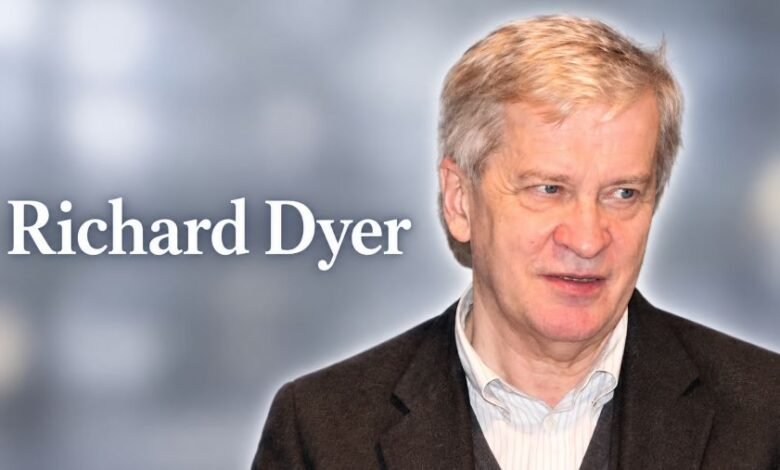
Richard Dyer is a British film scholar, cultural theorist, author and critic. He is best known for his work on film stars, representation, race, whiteness, entertainment, queer culture, film music and Italian cinema.
His academic career spans decades.
As of September 2026, Dyer is Professor Emeritus of Film Studies at King’s College London. The British Academy also lists him as a Professorial Fellow in Film Studies at the University of St Andrews.
He was elected a Fellow of the British Academy in 2012.
His 1979 book Stars became one of his best-known works. It helped make film stardom a serious subject of academic study.
Quick Facts About Richard Dyer
| Fact | Detail |
|---|---|
| Full professional name | Richard Dyer |
| Profession | Film scholar, author, critic and academic |
| Main academic field | Film Studies |
| Current status | Professor Emeritus at King’s College London |
| Current academic affiliation | Professorial Fellow at University of St Andrews |
| Former university | University of Warwick |
| Joined King’s College London | 2006 |
| British Academy | Fellow since 2012 |
| Education | University of St Andrews and University of Birmingham |
| Major early work | Stars |
| Stars publication year | 1979 |
| Other major books | White, Heavenly Bodies, Only Entertainment, The Culture of Queers |
| Major recognition | BAFTSS Lifetime Achievement Award |
| Recent honour | Stockholm University honorary doctorate, 2023 |
Who Is Richard Dyer?
Richard Dyer is an academic whose writing changed the way many scholars look at popular cinema.
That sounds simple. It was not.
Film scholarship once gave much of its attention to directors, stories and film style. Dyer pushed readers to look closely at something sitting right in front of them: the star.
How is a star image made?
What does publicity add?
What happens when films, magazines, interviews and photographs create different versions of the same public figure?
Those questions became central to his work.
His research later moved across many other subjects, including racial representation, queer culture, entertainment, music and European cinema.
Education and Academic Background
Dyer studied at the University of St Andrews.
He received an MA in French and also studied German, English and Philosophy.
He later went to the University of Birmingham, where he completed a PhD in English.
His doctoral work was connected with Birmingham’s Centre for Contemporary Cultural Studies.
That centre became closely linked with the growth of British cultural studies.
Popular media mattered there.
Television mattered. Music mattered. Film mattered. Everyday culture could be studied seriously.
This setting helped form the academic world in which Dyer began writing.
Early Work in Film and Gay Cultural Politics
Dyer was active in gay cultural and political circles during the 1970s.
He was connected with the Gay Left Collective and earlier took part in the Gay Liberation Front in Birmingham.
Film soon became part of that work.
In 1977, he organised Images of Homosexuality at London’s National Film Theatre.
The programme examined representations of gay and lesbian people in cinema.
A 2024 interview published in the journal Screen looked back at this period and Dyer’s role in the project.
He was not only writing about film.
He was programming it too.
Then came another piece that remained widely discussed: “In Defence of Disco.”
It appeared in Gay Left in 1979.
The essay treated disco as something worth serious cultural discussion, including its relationship with pleasure, identity and gay culture.
Richard Dyer at the University of Warwick
Dyer joined the University of Warwick in 1979.
Warwick became a major part of his academic career.
He taught Film Studies there for many years and later became a professor.
His work at Warwick came during a period when Film Studies was still growing as a university subject in Britain.
This matters.
Dyer was working in the field while many of its basic questions, methods and teaching traditions were still being built.
Why Stars Became So Important
Also in 1979, Dyer published Stars through the British Film Institute.
The book asked readers to think beyond an actor’s performance in one film.
A star exists across many places.
Films matter.
So do publicity photographs, interviews, advertising, magazines and public appearances.
Dyer examined how all these pieces build a star image.
That idea became highly useful for later researchers.
King’s College London has described Stars as an important work in establishing what became known as Star Studies.
The book remains closely tied to Dyer’s name.
Heavenly Bodies
Dyer returned to film stars in Heavenly Bodies: Film Stars and Society.
First published in 1986, the book looked closely at Marilyn Monroe, Paul Robeson and Judy Garland.
Here, stars were not treated as famous faces alone.
Their public images were connected with wider questions involving society, identity and culture.
The book later received a second edition.
It remains another key text in Dyer’s work on celebrity and screen identity.
Richard Dyer and Representation
Representation became another major part of his writing.
His book The Matter of Images examined how groups and identities appear in visual culture.
The subjects included stereotypes, sexuality, race, empire and whiteness.
These were not small side topics.
They sat near the centre of his research.
Dyer asked readers to look at what images say, how they say it and which assumptions can hide inside apparently ordinary representations.
Why White Drew Attention
One of Dyer’s most discussed books is White, first published in 1997.
The book studies how whiteness appears in Western visual culture.
Its main move was clear.
Rather than treating white identity as culturally neutral, Dyer examined it as a representation that could itself be studied.
He looked at film, photography and other visual forms.
Routledge later released a twentieth-anniversary edition in 2017.
The book remains strongly associated with academic work on race and representation.
Queer Film and Cultural Writing
Dyer also wrote extensively about gay and queer culture.
Now You See It examined cinema made by and about lesbians and gay men.
Another book, The Culture of Queers, brought together work dealing with gay and queer cultural history.
These books connect with his earlier film programming and political writing from the 1970s.
There is a clear line here.
He studied how identity appears on screen, but he also looked at the institutions, audiences and cultural settings around those images.
Entertainment Was Serious Work Too
Dyer did not treat entertainment as something academics should dismiss.
His book Only Entertainment looked at musicals, disco, performance and popular pleasure.
That title catches part of his argument.
Calling something “only entertainment” can make it sound unimportant.
Dyer’s work pushed against that idea.
Popular entertainment can tell us a lot about desire, social values and the ways audiences imagine a better life.
That became another strong part of his academic writing.
Film Music and Italian Cinema
His interests kept moving.
Dyer wrote about film music, songs and Italian cinema.
Nino Rota: Music, Film and Feeling examined the Italian composer who became closely associated with director Federico Fellini.
Dyer also wrote In the Space of a Song, which studied how songs work inside films.
Then there was Fellini.
Dyer wrote a BFI Film Classics book on La dolce vita.
His interest in Italian cinema also appears across his teaching and research record.
Work on Crime Cinema
Dyer later turned to serial killing in European film.
His 2015 book Lethal Repetition: Serial Killing in European Cinema examined the subject outside the usual American focus.
The book looked at European films and cultural settings.
Again, the subject changed.
His interest in representation stayed.
Move to King’s College London
After his long Warwick career, Dyer joined King’s College London in 2006 as Professor of Film Studies.
He later became Professor Emeritus.
King’s continues to list his main areas of research around entertainment, representation, film music, melodrama, Italian cinema and gay, lesbian and queer cultures.
His career has also included visiting posts at universities in places such as Stockholm, Copenhagen, New York, Naples, Weimar and Bloomington.
He held visiting roles at the University of St Andrews between 2011 and 2017 as well.
Major Awards and Honours
Dyer’s academic work has received recognition from universities and scholarly organisations.
In 2007, the Society for Cinema and Media Studies gave him Honorary Lifetime Membership.
He received an honorary doctorate from the University of Turku the same year.
In 2012, he was elected a Fellow of the British Academy.
Then came another major recognition.
In 2014, the British Association of Film, Television and Screen Studies gave Dyer its Lifetime Achievement Award.
Yale University also awarded him the James Robert Brudner ’83 Memorial Prize in 2014.
He received an honorary doctorate from Université Bordeaux Montaigne in 2018.
In 2023, Stockholm University named him one of its honorary doctors.
The Richard Dyer Reader
Dyer’s career received a major retrospective treatment in 2023.
The British Film Institute and Bloomsbury published The Richard Dyer Reader, edited by Glyn Davis and Jaap Kooijman.
The book brings together writing from roughly five decades of his work.
Its subjects include stars, entertainment, politics, whiteness, queer culture and film analysis.
For anyone trying to understand the range of Dyer’s academic interests, this collection gives a useful picture.
Richard Dyer and Seven
Dyer has also written about individual films.
One example is David Fincher’s Seven.
His BFI study of the film first appeared in 1999.
A new edition followed in 2024.
That edition included a fresh afterword from Dyer, giving him space to reconsider the film and its later reputation.
So, yes, his publishing record continued well beyond his move to emeritus status.
His Wider Public Work
Dyer’s work has not stayed inside university classrooms.
He has written for Sight and Sound and appeared in film, television and radio programmes.
His credits include an appearance in the documentary The Celluloid Closet.
He has contributed to BBC Radio 3, BBC Radio 4 and the BBC World Service.
He also programmed films for the National Film Theatre and other venues.
The BFI continues to maintain a profile connected with his work.
Why Richard Dyer’s Work Still Gets Read
There are several clear reasons.
Stars gave scholars a strong way to study celebrity as a constructed public image.
White asked readers to examine whiteness rather than leave it sitting unnoticed as a supposed default.
His queer film writing linked cinema with identity, politics and cultural history.
His work on entertainment took pleasure seriously.
Then his writing on music showed another side of film analysis.
Different topics. Same sharp question.
What is the image doing?
That question appears again and again across his work.
Verified Interesting Facts
- Dyer joined Warwick’s Film Studies staff in 1979.
- Stars was also published in 1979.
- He programmed the Images of Homosexuality film season in 1977.
- His essay “In Defence of Disco” appeared in Gay Left in 1979.
- His work ranges from Marilyn Monroe and Judy Garland to Federico Fellini and David Fincher’s Seven.
- The University of St Andrews has a Richard Dyer Prize for a top-performing Film Studies graduate.
- His 2024 edition of Seven included a newly written afterword.
- He became a Fellow of the British Academy in 2012.
Final Thought
Richard Dyer’s career cannot be reduced to one book.
Still, Stars is a good place to understand why his name matters.
He helped show that movie stars could be studied as cultural images, not simply famous actors.
From there, his writing moved into race, whiteness, queer culture, entertainment, music and European cinema.
His influence can still be seen in the questions film scholars ask today.
As of September 2026, he remains Professor Emeritus at King’s College London and is listed by the British Academy as a Professorial Fellow at the University of St Andrews.
Frequently Asked Questions
Who is Richard Dyer?
Richard Dyer is a British film scholar, cultural theorist, author and critic known for his work on stars, representation and popular cinema.
What is Richard Dyer best known for?
He is especially known for Stars, Heavenly Bodies, White, Only Entertainment and his work on queer film culture.
Where did Richard Dyer study?
He studied at the University of St Andrews and later completed a PhD at the University of Birmingham.
Where did Richard Dyer teach?
He spent many years at the University of Warwick before joining King’s College London in 2006.
What is Richard Dyer’s current position?
As of September 2026, he is Professor Emeritus of Film Studies at King’s College London.
Is Richard Dyer a Fellow of the British Academy?
Yes. He was elected a Fellow of the British Academy in 2012.
Why is Richard Dyer’s book Stars important?
The book helped establish film stardom as a serious area of academic study and influenced the growth of Star Studies.
Did Richard Dyer write about whiteness?
Yes. His 1997 book White examines how whiteness is represented in Western visual culture.